World AIDS Day
By Dr. Toni Pyke
Tuesday, 1st December is World AIDS Day.
It is four decades since the first UN observance of the day and nearly 5 decades since the reality of the pandemic was reported.
According to UNAIDS, some 92 million people have acquired the HIV virus since it was first diagnosed in 1981, and some 44.2 million people have died from AIDS-related illnesses. The global awareness campaign and support since then has seen AIDS-related deaths reduced by 73% from its peak in 2004 and by 57% since 2010. While this is good news, UNAIDS also report that in 2025, someone died of HIV-related causes every minute and that the total international response for financial and other commitments for HIV declined by 18% which is the largest decline in almost two decades.
What these statistics do not tell us are the stories of the real people across the world who are impacted by HIV and AIDS. These are the children, women and men whose lives are destroyed by the virus and the wider familial and societal impact of the loss.
St Teresa’s Parish Dublin 8 AIDS Memorial Windows – a unique and historic contribution
In a beautiful commemoration of the those who have died from AIDS related diseases and to those who cared for them during their illness, St Teresa’s Parish on Donor Avenue in Dublin recently installed two new stained-glass windows in remembrance of their lives and contributions.
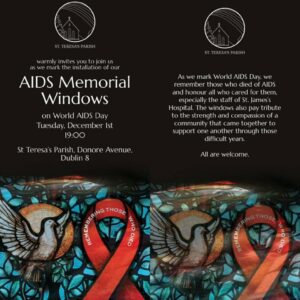
St Teresa’s Parish invite you to join them to mark the instillation of the AIDS Memorial Windows on World AIDS Day, Tuesday, December 1st at 19:00.
Click HERE to learn more about this initiative and the innovation, welcome and inclusivity of St Teresa’s parish as told by one of the parishioners.
St. Teresa’s Parish – a Marist welcome
As St Teresa’s parish church marks its centenary year, lots of changes have been recorded in the locality, also known for serious social challenges in the 1980s and the regeneration of the rows of Victorian houses, and the first houses built by the new State in 1922-1924, subsequently.
The Church, administered by the Marist Order has been working hard to reconnect its ministry with the very diverse community that now populates Dublin 8. It has a generous and inclusive approach and has a real welcome for all. This generosity has of course met with some protest, and the Church community has endured that and faced it down, confident in its own ministry and desire to enhance pastoral care. That innovation and sincerity does not of course wipe out or erase or excuse the actions of the Institutional Church that they are a component part of, but it does firmly reset its mission in the core compassion that should be at the centre of a church whose message is ‘God is love’. After Covid, the parish installed two windows to commemorate the impact on their community, whose hinterland includes St James’ Hospital.
About five years ago, the parish reached out to another of its communities and decided to hold a Service of Belonging during Pride month. They devised their own service in the first year, which I attended in support. The second year, they reached out to me to speak at their Service. It was a bit of a dilemma. I didn’t want to betray my tribe, as there is so much dreadful history around the Catholic Church and its treatment of the LGBT community. However, there is no point in wishing for change, if you fail to recognise it as it evolves. The Church is supported by an enlightened Parish Priest, clergy and an inclusive and compassionate pastoral team, who actually do understand their mission and their responsibility to the true to that calling.
I spoke about the history of the Catholic and all Christian churches role in discrimination, stereotyping and exclusion over the centuries, but I also challenged all to see the emerging common ground in such Services of Belonging. One commentary led me to the Covid windows. The memorial to the ‘first pandemic in a century’ when ‘we were all in this together’. It’s a lovely memorial, but of course the context is not complete. HIV and AIDS was the lethal predecessor of Covid and we were not in that together.
AIDS Memorial-Stained Glass Windows
I first moved into that community, where I knew other LGBT people lived. It was close to the city and within walking distance of the Gay quarter. I even knew same sex couples who lived together there. In appreciating the Covid memorial, I was reminded that one of my first memories of moving in, was driving home from work up Rutledge Terrace and many evenings seeing ‘removals’ arrive with flowers depicting ‘Mammy’ or ‘Daddy’ and grandparents clutching the hands of their grandchildren, who would now be reared by them. Drugs had afflicted the community and they too were exposed to the ravages of AIDS, which thrived in poor areas worldwide and in Ireland, and the inner city was no exception. At least this Church gave people a Christian burial. Not all did at that time.
I suggested that perhaps the parish might consider a memorial to the AIDS pandemic. They published the full text of my contribution on their parish website. In talking about the need for information and protection about AIDS, I mentioned the institutional opposition of the churches to condoms. Was I the first to say that word from the altar?!
Some time later, the International Dublin Gay Theatre Festival, which I founded in 2004, in my home on the South Circular Road, stood up to take on the Annual LGBT Christmas Carol Service, long held in the Unitarian Church. When I went to continue that tradition, the Unitarian church was no longer available. I reached out to St Teresa’s, and the welcome was swift and sincere. We were back, the church was full and the parish turned out in force. At the blessing, Fr David responded to my suggestion in June, saying they had been challenged by it. They discussed it and agreed it should be done, provided I help, of course! I was delighted and moved.
I put together a small support group to raise awareness and funds, but due to lengthy delays in the production and design process, it was impossible to get a design to promote in that campaign and I ended up funding it myself, to ensure its delivery. It is very important to remember, we can only learn, provided we remember. Too many months later, the windows came into being.
These two windows, designed and made locally, are a memorial to all who died from AIDS and all those who cared. They have been installed in St Teresa’s catholic church, in time for World AIDS Day 2026. It is the end of a long project, and a timely reminder of the impact AIDS had on this Dublin 8 parish and beyond, during the parish centenary year.
“The stigma was almost as lethal as the disease” – a testimony
As always, with me, there is a story behind it. I have spent my life volunteering and supporting good causes. My involvement with the arts and theatre often meant that people reached out for support from the arts, our shows, my artist friends etc, for their great causes. I had a commitment to HIV and AIDS. It decimated a generation, my generation, and did not discriminate in killing young and old, gay and straight, rich and poor, but the brunt of this was felt in the LGBT community, as gay men contracted it and lesbian women stepped up, as the pioneers of caring, for this disease of unknown consequences. The courage was astounding.
AIDS happened in Ireland in a dark time. Gay men were criminalised, so even information, accurate information and treatment was at times impossible to come by. A few brave people stepped forward. I recall an Australian actor friend of mine who was in his 20s then, describing his role as a ‘permanent mourner’. They buried the dead in the morning, cleared out their accommodation in the afternoon and visited the sick in the evening…and later…they danced!
I have written plays on the subject – Quilt (with a G in the middle of the Q), a docudrama about the impact of AIDS in Ireland. Some of my shorter plays ‘A Reminder’ discussed the triggering Covid did about a time being forgotten. The legacy of the generations of care, advocacy, fundraising and medical advancement lives today in U=U, the miracle of Undetectable equals Untransmissible. But it was a hard won, hard fought, a huge cost journey, by many globally. It is estimated that 40 million people have died of AIDS, dwarfing the death toll from Covid.
In my time, I helped my LGBT colleagues fundraise for Cairde, Open Heart House, Friends for Friends, Round Tower Housing Association and of course the Guide Clinic, which pioneered medical care in Ireland in St James Hospital. We knew nothing as young people, about sexuality in the 1980s, never mind understanding the impact of this rumoured killer. We couldn’t read about it anywhere. Men could not speak up as they would immediately be branded, but women did, major celebrities and politicians, to try to get funding and attention for this dreadful death sentence. It was foreign. “AIDS don’t bring it home” was one of the earliest ads about it. Dublin 8, Donore and Rialto lived through this, as it ravaged communities and as St James’ Hospital pioneered care.
The AIDS Memorial project online features incredible testimonies of remembrance, love, loss and advocacy. It is a tough read. I have included some in Quilt. The only cover young Irish people had was to emigrate, as so many did. Young lesbian and gay people in the 80s knew Ireland as a chilling place. They upped and left, many never to return. Many died being cared for by strangers in the AIDS hostels of the United Kingdom or United States. Many were anonymised, even in death. Records are few. Truth is scarce.
A friend of mine in his 20s took ill while on a weekend away in Europe. As he was being treated, he told the medics that he was HIV+. He died that weekend, though I had seen him just days before in fine form. Many people who died of AIDS were not only denied a name, but often a funeral. The problem now was how to get him home.
The Irish solution was that his aunt was married to a Fianna Fail Minister and his local TD was the Minister for Foreign Affairs, who had his State car driven onto the tarmac of Dublin airport, got out and walked the coffin into the airport himself. This contrasted with a few years earlier when a national newspaper deployed a young reporter to St James’ to record and publish the names of the people visiting a dying celebrity, Vincent Hanley. One of my ‘favourite’ stories is from an Irish Catholic bishop who decried the fact that he had not been ‘consulted’ on the content of one of the first simple information leaflets produced by the State. His outlook of ignorance and prejudice would have made quite a difference!
Another friend died suddenly much later of an ‘opportunistic cancer” (code word for AIDS) and still the word was never mentioned at the funeral. There is a stigma, and this still impacts on those diagnosed today, despite immense medical advances in treatment and support.
Over 40 million are estimated to have died worldwide. My own realisation meant living and dealing with the fear that any flu or bruise might be a sign of what this unknown disease was, when there was no conversation and no one to ask. AIDS killed many, the fear affected all.
In the 80s, my theatrical career as a director took off. I was in demand and work offers poured in. It wasn’t long before I broke into the UK market. I had won the Waterford International Festival of Light Opera, which was our ‘university’ as it exposed us to the work of UK companies and directors. I had won the Best Amateur Producer (Director) and the following year I gave up my day job to concentrate on theatre. I immediately won the Best Professional Producer (Director) ousting the gay UK ‘god’ who was undefeated for over a decade. He began to turn up in the locality of the companies I was producing in the UK.
My career in the UK took off, where I directed in York, Basingstoke, The Isle of Man, Neath, Rhyl, and was offered more. Then, at the National Operatic and Drama Association Summer school at a lunch, another gay man, a kind man, who managed the release of the performance rights to the shows, was on his way into lunch when ‘god’ stood up and declared in front of the entire 220 UK companies present, “Have you heard about poor Brian, he has it you know, not long now…” and sat down.
It was still the 80s. how do you defend yourself against that? Inverted homophobia has always been vicious. I noticed some UK people being overly kind to me at the next Waterford Festival and when I asked what was going on, a West End director colleague relayed the above story to me. I was horrified.
I rang a Musical Director friend in Edinburgh and another in the south of England, and both confirmed they had heard the story, despite it being pre-internet times. aids travels fast. My growing career there was over. I never again had another call, letter or enquiry from the UK, which had been at least half my workload. I never had HIV or AIDS, but I also didn’t have the resources to take all that hate on at that time. The stigma was almost as lethal as the disease. It certainly was commercially. It still can be.
Thankfully, my career took off professionally in Ireland and when my friend Gerry Sinnott MD of the Olympia Theatre, asked me to choose from the many charity applications to benefit from my Christmas show (free tickets etc), I said my chosen charity was AIDS.
Theatre and the arts had been to the forefront of the worldwide visibility, but it was not so visible here. He didn’t bat an eyelid and AIDS ribbons were sold, the children with AIDS were given free tickets etc, and I allowed collections at the end, when requested. I also supported the other charities who applied.
Then I had success playing the lead in the musical ‘La Cage Aux Folles’ in Dublin, Waterford and the Olympia. ‘La Cage’ had taken Broadway by storm and won many awards. It transferred to the West End later but closed after a few performances at the height of the AIDS pandemic, which was decimating the companies and chorus lines of many West End shows. Too few wanted to be entertained by a storyline where the characters would be assumed to end in death. It took many years for ‘La Cage’ (‘I Am What I Am’) to emerge again as a classic in musical theatre.
I did the first Irish production in 1993, only weeks after being gay was finally decriminalised in Ireland. It was a ‘revolution’ and sold out. I won the best Actor Award at the Waterford International Festival – that too ended my work as an actor, despite winning an award and standing ovations. Once you play gay, that was it! There was however, a huge demand for the character in the LGBT+ community and I was offered many jobs to perform and appear. I turned them down.
Then, an AIDS charity approached me and said they wanted me to perform but heard that I wouldn’t. I replied, ‘you have asked me a different question’! So, I devised a number of cabaret shows where I appeared as myself and my alter ego, provided they benefitted AIDS charities. I did many shows for AIDS and LGBT causes over the next few years.
In truth, I was hardly touched by that pandemic, but the ghosts of my handsome generation often flash though my mind. Where were these faces from my youth? In the LGBT community, we rarely knew each other’s real name, many emigrated, some were lucky to settle down and left the ‘scene’ but others were never heard of again. Sometimes, you would hear they had died.
I carried all of that into my theatre work and referred to those times as ‘the Ireland of concealment’ where so many voices could not be heard and stories not allowed to be told. It prompted me to establish the International Dublin Gay Theatre Festival to remedy that absence. I became part of the ‘explaining generation’.
Fast forward again to my local parish, now celebrating its centenary, with a real mission to address the spiritual needs of their parishioners. “Dublin 8 isn’t Straight” I suggested in my Pride Service speech. I had lived next door to the parish clergy and got to know them as people. I was impressed. I knew of them reaching out to many, including LGBT+ parishioners, whether they engaged with the Church or not, when in need. Our conversations grew.
I asked had any church an AIDS memorial window? Had this been done before? I came across a church in New York that had a commemorative collection of wall plaques naming those who died from AIDS. It was accessed by the back stairs to the organ loft. The Church was sold in 2017. I think this is a first.
I am grateful to the few friends who rallied to support the project, but we were constantly thwarted by the slow window production process. We were left with nothing to base a fundraising or awareness programme to support the installation of the pair of windows, remembering those who died and those who cared. I had a decision to make to ensure it went ahead. It was too important not to proceed. Perhaps, after a lifetime of volunteering, it is likely that this will be my last volunteer project and it is certainly worth doing!
The lengthy design process was draining and that was disappointing. The parish remained steadfast in its commitment and there was a huge buy-in for the themes selected. They were focussed as how do you include the 40 million who died and the many more who cared. The themes emerged as follows and the engagement by the parish team in teasing them out was incredible, detailed and so supportive. We were all on the same page and the harmony was palpable. Thank you.
You are free to interpret the windows and the themes as you see fit. It is a memorial for everyone.
The AIDS windows:
Window 1:
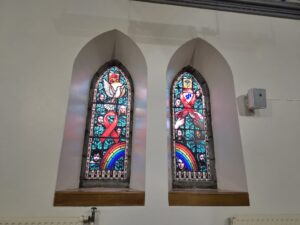
On the first window ‘remembering those who died’ – we have the red rose of St Teresa, and the depiction of the Holy Spirit. There are generic pictures of people of all ages and races. AIDS did not discriminate. The rainbow, a symbol of the qualities celebrated in the LGBT identity and indeed shared by many in the religious community, such as Life, Healing, Sunlight, Nature, Art, Serenity and Spirit are present. These themes are also included in the Covid windows.
The red Aids ribbons are central. They are the emblem worn by those who supported the cause, the advocacy, funding and research. It is visibility. There is an alphabet at the end of both windows, to allow any visitor to spell the name of their lost ones.
Window 2:
Completes the picture, including the rainbow arc. Oscar Wilde was a canny marketeer. He discovered green carnations in Paris and imported them back to London (where he claimed he invented them). He asked his gay friends to wear a green carnation to the opening nights of his successful plays. If the critics didn’t like the play (they did!) then he would get the column inches in the gossip and society pages, speculating what they meant. The wording remembers ‘those who cared’. There were many who didn’t. May many reflect on why that was and make sure it never happens again.
The arts and theatre community worldwide was ravaged by AIDS. It happened in front of audiences. It was rare visibility for a pandemic confined to the shadows. It is fitting that Wilde’s emblem, which I used as the emblem of the International Dublin Gay Theatre Festival, founded locally, represents that coded community who were impacted so much. The St James’ hospital logo embraces all who cared, the families and friends, the doctors, nurses and experts, their communities, their kindness and courage. All the hands holding the ribbon, signify the global help given by so many. The Ivy shows the extent of the coverage of the disease, which spreads like a quilt. The additional black stripe on the rainbow signifies the mourning by those who cared.
Read into it what you will. It is there now for all to consider. They are remembered. May it also be a reminder that even though we were not ‘all in this together’ then, we can be now. We have changed.
I am deeply grateful to St Teresa’s Parish for remembering the experiences of all their parishioners and all worldwide, by including these memorials in their church. I hope people will visit, be comforted and maybe light a candle for all who died and all who cared.
We can learn from the solidarity, courage, generosity and dignity of those few who stood up when the many were too scared. May all now rest easy. You are remembered.